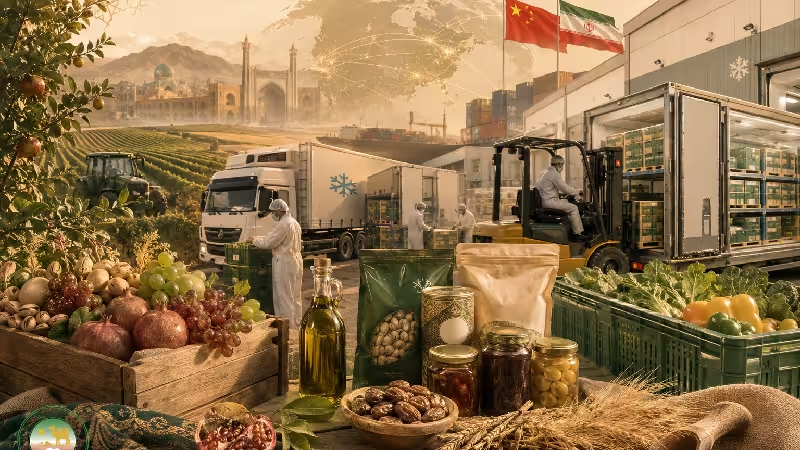


Alongside these achievements, one of the most important lessons of this period was the significance of the country’s economic resilience. The experience of the war demonstrated that wherever precise planning, intelligent policymaking, coordination among different sectors, and active private-sector participation exist, it is possible to prevent the emergence of severe economic crises and maintain relative stability, even under the most difficult circumstances.
This valuable experience can now become an important asset for the post-war period. Just as cohesion and effective management led to success in the field of national defense, strategic planning, the expansion of foreign trade, investment attraction, and the effective use of international opportunities can lay the foundations for sustainable economic growth.
Today, the post-war period should not be understood merely as a time for rebuilding what has been damaged. It should also be viewed as an opportunity to reshape economic structures, modernize industries, develop infrastructure, and enhance Iran’s position within regional and global value chains.
Under these circumstances, economic diplomacy must become one of the country’s highest priorities. In today’s world, competition among nations is no longer limited to securing markets; it also extends to attracting investment, technology, technical expertise, supply chains, and development opportunities. Successful countries will be those capable of connecting their domestic strengths with international opportunities and utilizing the global economy in support of their national interests.
In this context, the People’s Republic of China—as the world’s second-largest economy, the leading global manufacturing power, and one of the most influential participants in international trade and investment—can occupy a distinctive position in Iran’s post-war economic strategy.
Developments in recent years indicate that China’s foreign economic policy has entered a new phase. Chinese companies are no longer focused solely on exporting goods; they are making extensive investments in infrastructure, industrial and energy projects, transportation, emerging technologies, the digital economy, and global supply chains. The Belt and Road Initiative, as the world’s largest infrastructure development program, also reflects China’s determination to expand long-term economic cooperation with countries around the world.
Iran’s post-war economy requires a new generation of international partnerships. The era of import-only relationships and limited commercial engagement can no longer meet the country’s development needs. More than ever, Iran must move toward joint investment, technology transfer, the establishment of production lines, the development of research and development centers, the financing of infrastructure projects, and long-term industrial partnerships.
At the same time, Iran’s economic reconstruction and modernization market could become one of the region’s largest investment opportunities in the coming years. Transportation infrastructure development, industrial modernization, increased production capacity, smart-city development, energy projects, rail transportation, ports, logistics, and emerging technologies are all areas with considerable potential to attract international investment and participation.
In this regard, the role of trade centers, chambers of commerce, development institutions, and specialized networks of Iranians active in China is more important than ever. These organizations can serve as connecting links between Iran’s economic opportunities and China’s investment capabilities, helping to create the foundations for sustainable joint projects.
Without question, the future of Iran’s economy cannot be limited to rebuilding what has been lost. It must be defined by the development of next-generation infrastructure, the attraction of productive investment, the expansion of international trade, the empowerment of the private sector, and the effective use of the valuable capabilities of Iranians around the world.
The post-war economy can mark the beginning of a new chapter in Iran’s national development—a chapter in which trade, investment, technology, knowledge, and strategic cooperation serve the country’s economic growth. Along this path, China can be not only an important trading partner but also one of Iran’s most significant development partners over the coming decade. Achieving this objective requires careful planning, intelligent policymaking, and the maximum utilization of all national and international capabilities. If managed effectively, these capabilities can transform the post-war period into the starting point of a historic economic leap for Iran.