
Professional Communication: The Foundation of Successful Cooperation with China
Trade with China—whether for individuals and independent traders or for companies, manufacturers, and economic institutions—does not simply begin and end with finding a seller or buyer. A significant part of success in this field depends on the quality of communication, the manner of correspondence, negotiation methods, the accurate communication of requirements, and continuous follow-up with Chinese counterparts. Many commercial opportunities are lost not because of a lack of products or markets, but because of weak communication, misunderstandings, incomplete correspondence, or unprofessional negotiations.
The Chinese market is extensive, dynamic, and highly competitive. Chinese companies generally communicate with numerous customers and partners from around the world. In such an environment, the party that presents its requirements more accurately, professionally, and systematically is more likely to succeed. In contrast, irregular correspondence, vague questions, continuously changing requirements, a lack of clear technical information, or weak follow-up can reduce the confidence of Chinese counterparts and make cooperation more difficult.
In this context, Iran Hangzhou Trade Tower can serve Iranian individuals and legal entities as a communications link, business-correspondence adviser, and negotiation support partner in their engagement with Chinese counterparts. With its understanding of China’s commercial and communications environment, it can help ensure that negotiations and correspondence are conducted more accurately, formally, systematically, and with a stronger focus on results.
Why Does Communication with Chinese Companies Require Particular Care?
Commercial communication with Chinese companies is not merely a matter of translating a few sentences from Persian into Chinese or English. What matters in many cases is the accurate communication of concepts, objectives, terms, expectations, technical details, and the commitments expected by the Iranian party. An ambiguous sentence in correspondence, an incorrect figure in technical specifications, a misunderstanding regarding payment terms, or uncertainty about delivery time may develop into a serious dispute at a later stage.
Cultural differences are also important in negotiations with Chinese counterparts. Chinese businesses generally value gradual relationship-building, trust, regular follow-up, mutual respect, and a clearly defined framework for cooperation. Short or indirect responses from a Chinese counterpart may sometimes appear unclear to an Iranian party, while excessive directness or haste on the Iranian side may not be viewed positively by the Chinese party. Managing these differences forms part of the skills required for effective business communication with China.
For individuals, these sensitivities are most commonly encountered when beginning a purchase, requesting quotations, ordering samples, making payments, and following up on orders. For legal entities and companies, the scope is broader and may include contract negotiations, long-term cooperation, continuous sourcing, product exports, representation agreements, investment, technology transfer, or exhibition participation.
The Role of Professional Correspondence in Trade with China
Business correspondence creates the first formal impression of an Iranian individual or company in the mind of a Chinese counterpart. In many cases, cooperation begins with an email, message, letter of introduction, request for quotation, or catalogue submission. Accurate, respectful, systematic, and professional correspondence increases the likelihood of receiving an appropriate response and continuing the conversation.
Correspondence with a Chinese party should clearly state who the Iranian party is, its objectives, the product required, the intended order quantity, important technical or commercial specifications, the required delivery time, and the type of cooperation being sought. Correspondence that contains only a general question about price will not normally produce an accurate or reliable response.
Iran Hangzhou Trade Tower can provide support by preparing business correspondence, accurately communicating the Iranian party’s requirements, raising appropriate questions, obtaining supplementary responses, and organizing communications with Chinese companies.
Negotiations for Individuals
Individuals, independent traders, shop owners, online retailers, and those intending to enter trade with China for the first time generally encounter several important challenges when negotiating with Chinese counterparts. They may not know how to obtain a realistic price, what questions to ask about the product, how to negotiate the minimum order quantity, which documents to request from the seller, how to obtain samples, or which conditions should be clarified before payment.
Chinese sellers often provide general answers to general questions. The Iranian party should therefore know precisely what information is required and how to request it. Product quality, production time, packaging type, payment terms, domestic transportation costs in China, private-labelling options, warranties, spare parts, applicable standards, and conditions for replacing or correcting goods are all matters that should be clarified before a decision is made.
Iran Hangzhou Trade Tower can guide and support individuals during initial correspondence, information collection, comparison of responses, preparation of more precise questions, communication of requirements, and follow-up on negotiations with Chinese counterparts.
Negotiations for Legal Entities and Companies
Legal entities, trading companies, factories, brands, knowledge-based enterprises, and economic institutions generally require a more professional framework when negotiating with Chinese parties. Such negotiations may relate to continuous sourcing, machinery purchases, exports of Iranian products, technological cooperation, establishment of representation, commercial partnerships, exhibition participation, or implementation of joint projects.
Price is not the only important consideration in these negotiations. Production capacity, the obligations of both parties, scheduling, technical specifications, standards, payment terms, transportation methods, after-sales services, confidentiality, brand ownership, packaging requirements, quality control, and dispute-resolution procedures must also be addressed.
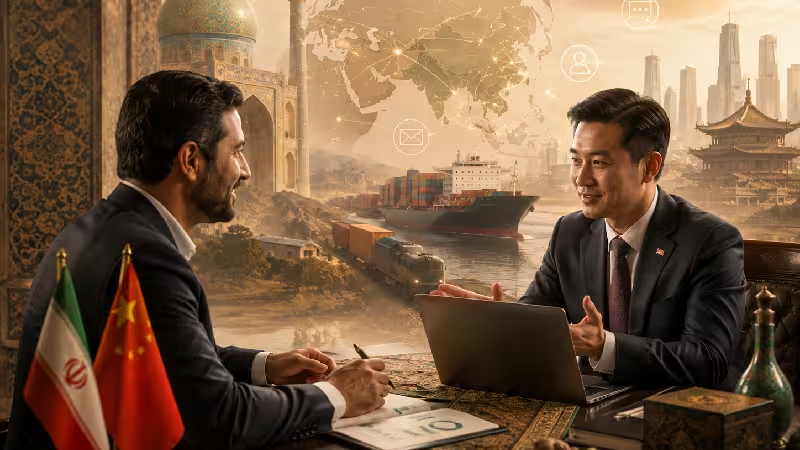
Iran Hangzhou Trade Tower can assist Iranian companies by coordinating meetings, preparing agendas, formally introducing the Iranian company, accurately communicating proposals, following up on responses, summarizing negotiations, and developing sustainable relationships with Chinese counterparts. These services can help Iranian companies move away from fragmented negotiations and manage their discussions through a more structured and traceable framework.
The Importance of Professionally Introducing the Iranian Party
The manner in which the Iranian party is introduced is highly important when negotiating with Chinese companies. An Iranian company or individual can attract the attention of a Chinese counterpart when presented clearly, credibly, and professionally. Such an introduction may include business history, field of activity, products or services, production or purchasing capacity, target markets, examples of previous cooperation, catalogues, website, licenses, and the proposed cooperation plan.
An Iranian company may possess considerable capabilities but fail to establish effective communication because of a weak introduction, the absence of appropriate presentation materials, poor translation, a lack of a presentable catalogue, or disorganized communication of its requirements. This is particularly important when exporting Iranian products to China, as Chinese counterparts need to develop an acceptable initial understanding of the product, company, and potential for cooperation within a short period.
Iran Hangzhou Trade Tower can play an effective role in preparing the introduction process, developing initial content, coordinating the presentation of information, and professionally communicating the Iranian party’s message to Chinese counterparts.
Managing Linguistic and Cultural Misunderstandings
Linguistic and cultural misunderstandings are among the principal challenges in communicating with Chinese counterparts. Many negotiations are conducted in English, but differences in language proficiency, specialized terminology, and interpretation may create ambiguity. Communication in Chinese may also be required, particularly when dealing with a local factory, specialized manufacturer, or company with limited international experience.
Misunderstandings are not limited to language. A short response, a delay in replying, a price adjustment, a request for an advance payment, or an indirect statement may have one meaning for the Iranian party and another for the Chinese party. Managing these differences requires experience, patience, and attention to detail.
By serving as a communications intermediary, communicating concepts more accurately, clarifying uncertainties, and ensuring regular follow-up, Iran Hangzhou Trade Tower can help prevent many potential misunderstandings.
Price Negotiation: Looking Beyond the Final Figure
Price negotiation is highly important in trade with China, but the final figure is only one component of the transaction. A lower price may lead to reduced quality, changes in raw materials, the removal of appropriate packaging, longer delivery times, or more limited services. Professional negotiations should therefore consider price, quality, order quantity, packaging, payment terms, production time, transportation, and the obligations of the other party simultaneously.
For example, two suppliers may offer different prices, but one may provide higher quality, more complete packaging, or more reliable delivery terms. Under such circumstances, selecting a supplier solely on the basis of the lowest price may involve significant risks.
Iran Hangzhou Trade Tower can help Iranian individuals and companies compare proposals, clarify differences, raise supplementary questions, and negotiate more suitable purchasing or cooperation terms.
Arranging Business Meetings and Following Up on Negotiations
Many commercial negotiations with China require organized meetings, whether in person or online. Coordinating meeting times, introducing the parties, defining discussion topics, preparing information, recording key points, and following up on agreements after the meeting all affect the success of the negotiations.
Sometimes a business meeting is held but produces no practical result because there is no clear agenda, the parties are insufficiently prepared, or no follow-up occurs afterwards. A commercial negotiation becomes valuable when the agreed matters, outstanding questions, required documents, and next steps are clearly identified after the meeting.
Iran Hangzhou Trade Tower can provide effective services to individuals and legal entities by coordinating meetings, supporting communication, summarizing negotiations, and following up on subsequent stages.
The Role of Contracts and Written Agreements
When negotiating with Chinese counterparts, many agreements should be recorded clearly in writing. Relying on verbal discussions or fragmented messages is not sufficient for serious commercial transactions. Product specifications, quantity, price, delivery time, payment terms, packaging, standards, inspection, transportation, responsibility for non-conformities, and the obligations of both parties should be clarified as far as possible.
Documenting agreements does not mean making cooperation unnecessarily complicated; it is a tool for reducing future disputes. The clearer the details of a transaction, the lower the likelihood of misunderstandings and disagreements.
Iran Hangzhou Trade Tower can support the written documentation of agreements, clarification of ambiguous matters, and accurate communication of commercial terms between Iranian and Chinese parties.
Business Communication at Chinese Exhibitions
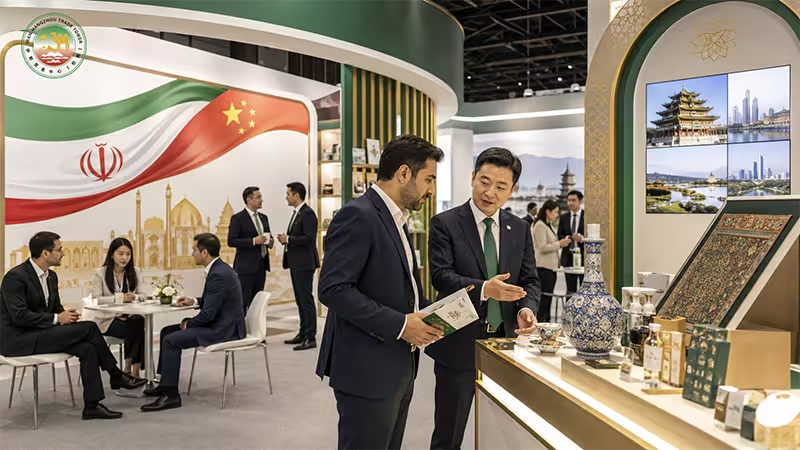
Chinese exhibitions are among the most important opportunities for direct negotiations with Chinese companies. At exhibitions, Iranian individuals and companies can communicate with Chinese manufacturers, buyers, exporters, distributors, and economic institutions. However, successful exhibition participation depends on preparation before attendance and follow-up after the event.
In many cases, an Iranian visitor returns from an exhibition with numerous business cards and catalogues, but the opportunities are lost because the information has not been categorized correctly or negotiations are not followed up. Exhibition negotiations should be targeted, documented, and traceable.
Iran Hangzhou Trade Tower can provide practical services by scheduling exhibition meetings, accompanying conversations, introducing the Iranian party, collecting information, categorizing contacts, and following up after the exhibition.
Long-Term Communication with Chinese Counterparts
Successful trade with China is generally not the result of short-term or occasional communication. Many valuable partnerships develop when trust, familiarity, and continuous interaction are established between the parties. This is particularly important for suppliers, buyers, distributors, commercial partners, and economic institutions.
Long-term communication requires follow-up, mutual respect, fulfilment of commitments, transparency of requirements, management of disagreements, and the maintenance of professional contact. Iran Hangzhou Trade Tower can support and coordinate the preservation and development of these relationships for Iranian businesses.
The Role of Iran Hangzhou Trade Tower
Iran Hangzhou Trade Tower seeks to transform communication between Iranian businesses and Chinese counterparts into a systematic, professional, and traceable process. It can provide significant services to individuals and legal entities in correspondence, negotiations, introductions, meeting coordination, response follow-up, communication of requirements, management of misunderstandings, negotiation summaries, and the development of commercial relationships.
The principal value of these services lies in ensuring that the Iranian party is not left with only a name or telephone number in China, but can manage its communications more accurately and confidently through an Iranian organization based in the country.
Conclusion
Negotiation, correspondence, and business communication with Chinese counterparts are among the most important components of trade with China. Many successful transactions begin with professional communication, while many problems originate from a misunderstanding or incomplete correspondence.
For individuals, these services can make the process of beginning trade, purchasing goods, obtaining quotations, and following up on orders easier and less risky. For legal entities and companies, they can facilitate structured negotiations, long-term cooperation, export development, product sourcing, exhibition participation, and sustainable engagement with the Chinese market.
With a professional, communications-oriented, and operational approach, Iran Hangzhou Trade Tower can accompany Iranian businesses in negotiating and engaging effectively with Chinese counterparts—a process in which proper communication can be transformed into sustainable cooperation and successful trade.